
How to Build a Daily Futures Trading Game Plan
A practical one-page game plan for the futures session: direction and uncertainty, prior-day, overnight and session levels, VWAP, long and short scenarios, no-trade conditions, and account-specific risk with combined exposure.
The HESTOL Team6 min read
On this page
A game plan is not a forecast. It is a short written record of what you expect, how confident you are, what would prove you wrong, and what you will do in each case — finished before the session starts, so the important decisions are already made when the market gets fast.
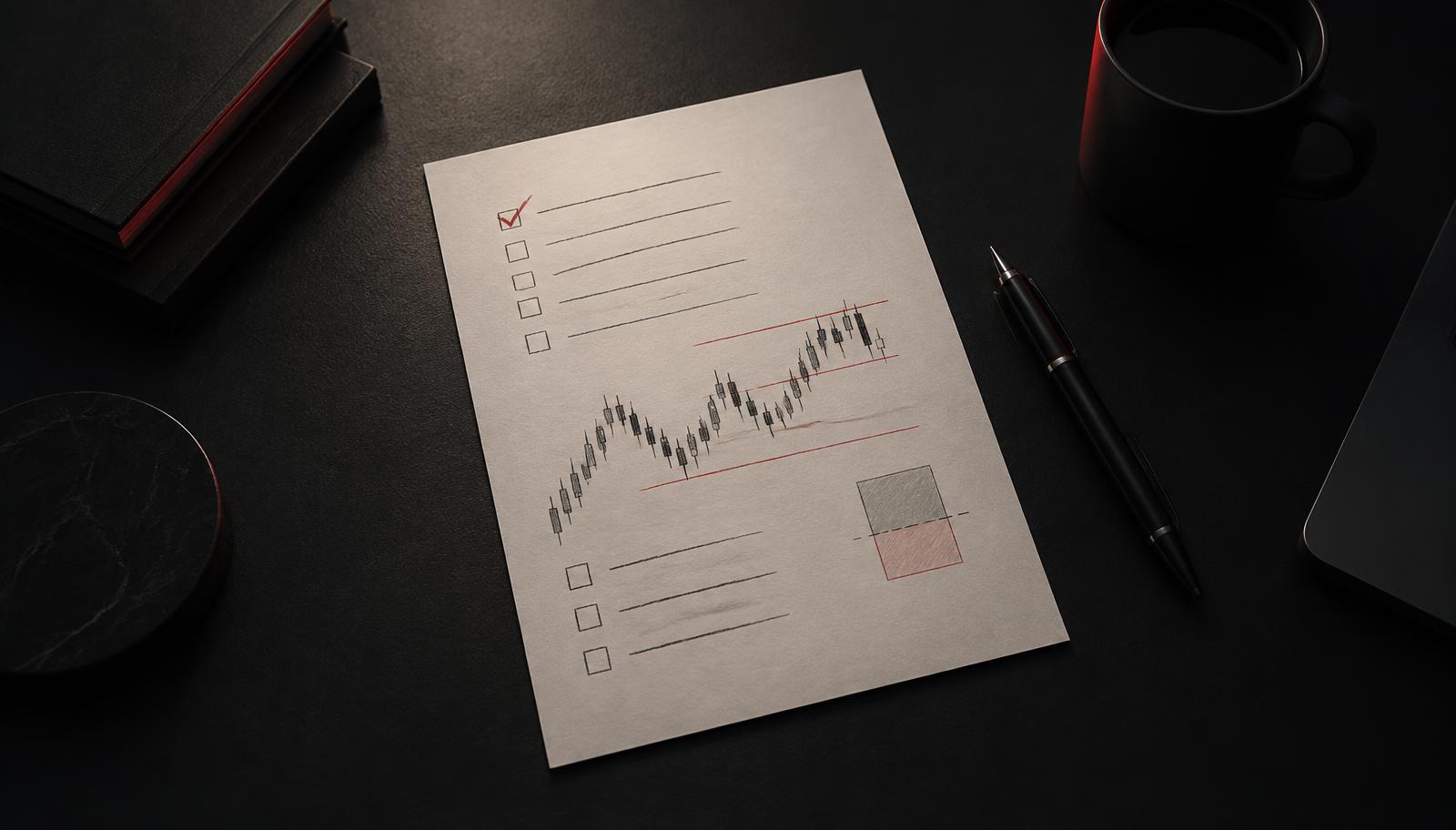
1. Market direction — and how sure you are
Start with one sentence about direction and the evidence for it: where price closed relative to the prior session's range, how the overnight session traded, and whether the higher-timeframe structure agrees. Then add a second sentence about uncertainty. "Leaning higher, low conviction — overnight range is narrow and a scheduled release is due at 10:00" is more useful than "bullish", because it tells you how much size and patience the day deserves.
Finish the section with the level or condition that cancels the bias. A bias without a cancel condition tends to become something you defend rather than test.
2. Prior-day, overnight and session levels
Mark a short list of reference levels — the fewer, the more likely you are to respect them:
- Prior-day high, low and settlement
- Overnight high and low
- Opening range high and low once it forms (for example, the first 15 or 30 minutes), if your setups use it
- Today's session high and low as they develop
- One higher-timeframe level you already trade from
Many traders draw these in a charting platform such as TradingView and then copy the values into their written plan. That works well — but they are separate tools. HESTOL does not connect to TradingView, so the written plan is where the numbers live for your review.
3. VWAP as context, not a signal
Volume-weighted average price summarises where volume has traded during the session. Write down how you will use it — for instance, only considering longs while price holds above session VWAP, or treating a reclaim of VWAP as one confirmation among several. State which VWAP you mean (session or anchored to a specific event) so your review later compares like with like.
4. Long and short scenarios
Write both sides, even when you have a bias. Each scenario needs four parts:
- Trigger — the price behaviour that makes the idea worth watching.
- Confirmation — what must also be true before you act (for example, two consecutive closes beyond a level while holding VWAP).
- Invalidation — what cancels the idea before entry (it never confirms) and after entry (your stop or a structural break). Keeping these separate helps the review: an idea that never triggered is different from one that triggered and failed.
- Management — the target, or the rule for taking profit and moving the stop.
5. No-trade conditions
Deciding when not to trade is part of the plan. Write the conditions that apply today:
- A scheduled release inside your window that you have decided not to trade through
- Price chopping inside the opening range with no clean trigger
- You have reached your daily loss limit or maximum number of trades
- You are tired, distracted, or trading to recover a loss
6. Account-specific risk and combined exposure
Write risk limits per account, as numbers, before the session: risk per trade, daily loss limit, maximum number of trades, and what you will do when a limit is reached. If you trade an evaluation or funded account, copy its rules from the firm's current documentation rather than from memory — they differ between firms and change over time.
Then check combined exposure. Two positions that each look small can add up to one large bet: the same contract in two accounts, or NQ and ES positions in the same direction, which often move together. Add the planned dollar risk of everything you might hold at once and make sure the total still fits the smallest daily loss limit it would hit.
7. A worked example (fictional)
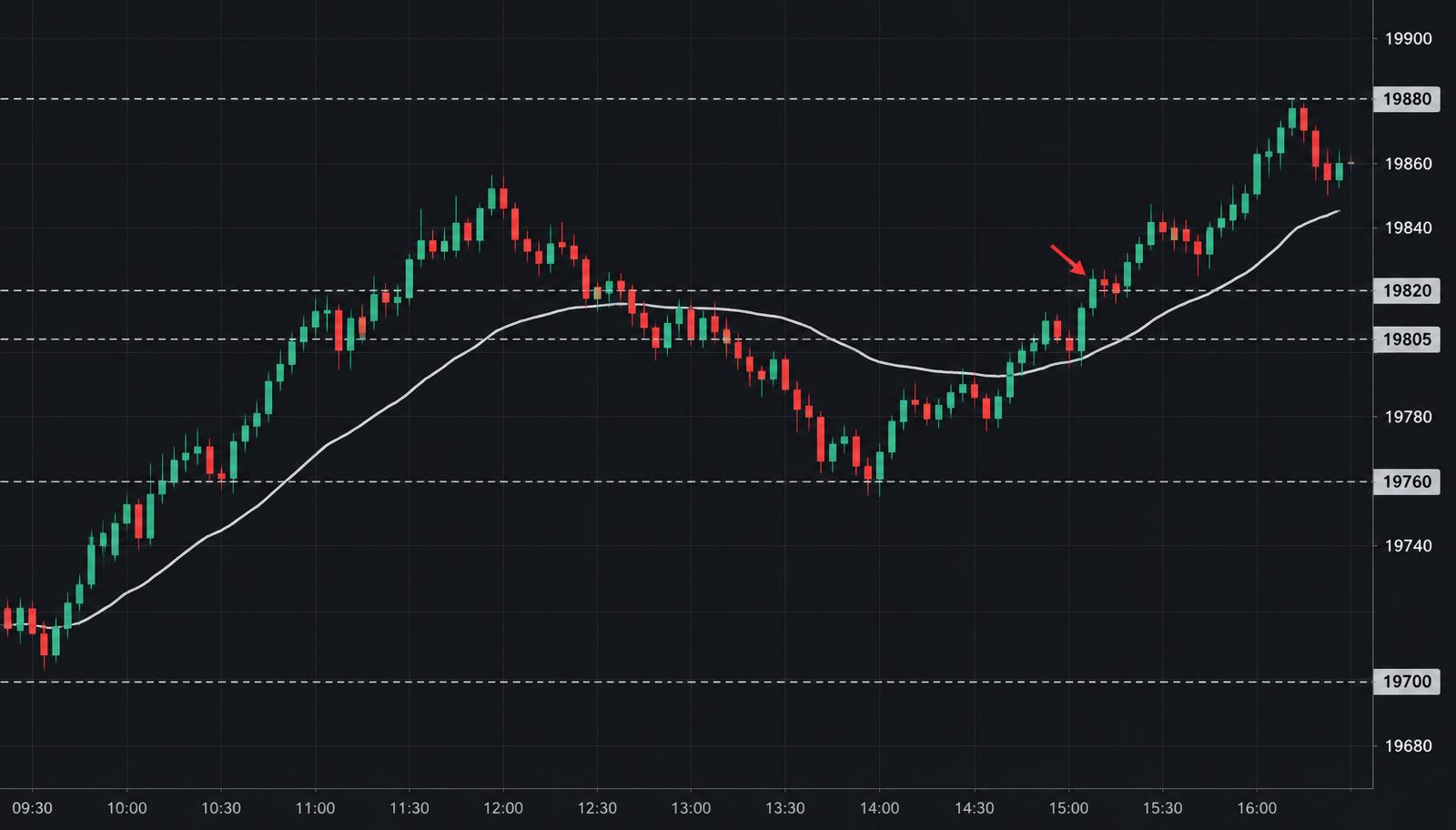
Direction: leaning higher, low conviction. Price settled near the top of the prior-day range, but the overnight range was narrow and a scheduled release is due at 10:00. The bias is cancelled by a sustained move back below 19,790.
Swipe horizontally to view the full table.
| Level | Price |
|---|---|
| Prior-day high | 19,880 |
| Overnight high | 19,820 |
| Prior-day settlement | 19,805 |
| Overnight low | 19,760 |
| Prior-day low | 19,700 |
Swipe horizontally to view the full table.
| Long scenario | Short scenario | |
|---|---|---|
| Trigger | Reclaim of 19,820 (overnight high) | Rejection at 19,820 after a test |
| Confirmation | Two consecutive closes above 19,820 while above session VWAP | Close back below session VWAP |
| Invalidation before entry | No confirmation by 10:00, or price loses VWAP first | Price accepts above 19,820 instead |
| Stop after entry | 19,795 | 19,845 |
| Management | Target prior-day high 19,880; stop to entry after +1R | Target overnight low 19,760 |
Risk: one MNQ contract is $2 per index point. A long from 19,822 with a stop at 19,795 risks 27 points — $54 per contract before commissions. Two contracts in each of two accounts means $108 at risk per account and $216 on the same idea in total. If the smaller account has a $400 daily loss limit, two failed attempts would use $216 of it — which is why the plan also caps the day at two losing trades, and why the $216 combined figure, not the $54 per contract, is the real size of the bet.
No-trade conditions for the example: no new entries from 09:55 to 10:05 around the release; stop for the day after two losing trades.
8. A checklist you can copy
One-page game plan checklist
- Bias in one sentence, with its uncertainty and the condition that cancels it
- Prior-day high, low and settlement; overnight high and low
- Opening range and session levels you will track
- Which VWAP you use and how
- Long scenario: trigger, confirmation, invalidation, stop, management
- Short scenario: trigger, confirmation, invalidation, stop, management
- No-trade conditions for today
- Per account: risk per trade, daily loss limit, maximum trades
- Combined exposure across accounts and related contracts
- What you will do when a limit is reached
After the session, compare what happened with what you wrote: which scenario triggered, whether you waited for confirmation, and whether you respected invalidation. That comparison is where the plan earns its keep.
See a sample execution plan — thesis, confirmation conditions and invalidation — beside market context in the HESTOL Trading Desk demo (fictional data, scripted responses).
Open the Trading Desk demoKeep your plan, session notes and trade records together for review in a futures trading journal.
See the trading journalAbout the author
The HESTOL Team — HESTOL is a futures-first trading workspace built by Lorthen Software LLC, combining journaling, session preparation, and trading workflow tools. Articles are written by the team building the product.
Explore the HESTOL workflow
See how a written plan, market context, and post-session review connect in the simulated journal.